


Reseña del libro
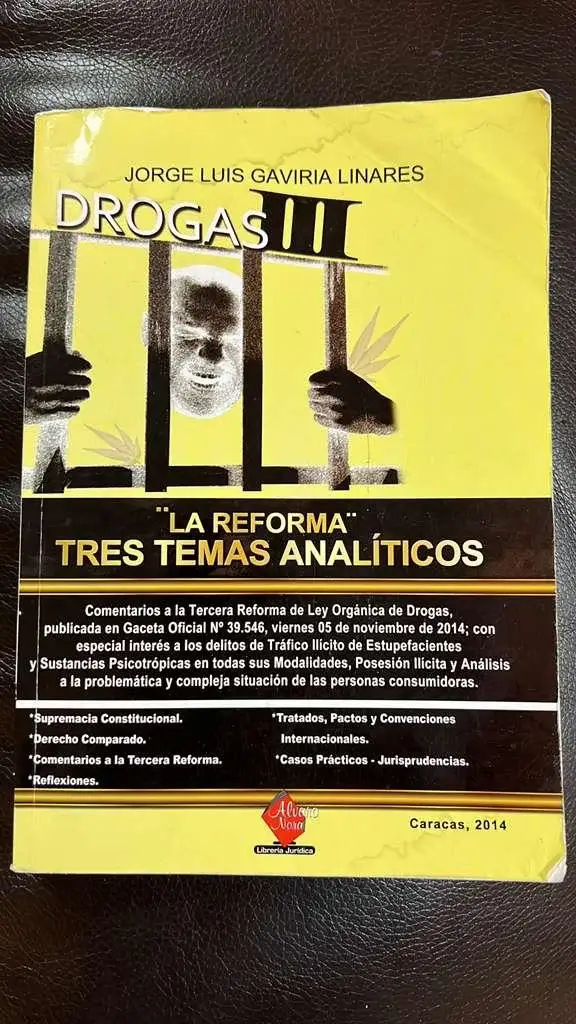
Writing Drugs III The Reform, I consciously took on a different challenge than the previous works. If in the first books the emphasis was placed on the analysis of crime and immediate legal practice, in this third volume I decided to focus the reflection on a crucial moment in Criminal Law: the reform. Reforming the law is not a merely technical act; It is, above all, a political, legal and moral decision that defines the direction of justice in a society.
This work arises from the need to carefully examine how legal reforms on drugs impact not only the regulatory texts, but also the real lives of people, the actions of justice operators and the coherence of the penal system. Throughout my career I have observed that many reforms are promoted hastily, without a thorough evaluation of their practical consequences. This book seeks precisely to stop, analyze and reflect.
In Drugs III The Reform I address three analytical topics that I consider fundamental to understanding the scope and implications of regulatory changes regarding drugs. This is not a chronological exposition of legal reforms, but rather a critical examination of their foundations, the criteria that support them and the results they produce in the daily application of the Law.
The first axis of analysis focuses on the reason for the penal reform.
The first axis of analysis focuses on the interest in unraveling what motivates the legislator to modify the existing regulations and whether these motivations really respond to criteria of justice, proportionality and effectiveness. Here I raise essential questions: does the reform address a real social need? Does it correct deficiencies in the previous system? Or does it simply introduce new interpretative tensions? into the reason for the penal reform.
The second analytical topic delves into the jurisprudential interpretation after the reform. Experience shows that any legal modification generates a period of uncertainty in the courts.
In this book I examine how judges have accepted the regulatory changes, what criteria have prevailed, and how jurisprudence has contributed—or not—to providing coherence to the new legal framework.
This review is not descriptive, but evaluative, aimed at identifying interpretive successes and risks.
The third axis addresses the social and human dimension of the reform. No criminal law is neutral.
Each reformed article has concrete effects on individuals, families and communities. From this perspective, I reflect on the relationship between criminal policy, social control and human dignity, defending the idea that Criminal Law cannot be separated from its ethical and social function.
I have written this work with deliberately clear language, without renouncing technical rigor. My goal is that the reader—whether judge, prosecutor, lawyer, student, or researcher—can understand not only the content of the reform, but also its profound implications.
Expository clarity is, for me, a form of respect for the reader and for the Law itself.
This book is not intended to offer definitive answers or absolute solutions. Rather, it seeks to provoke reflection, stimulate informed debate, and provide conceptual tools for a responsible interpretation of the law.
I firmly believe that penal reform should be a thoughtful process, not an impulsive one; humane, not merely punitive.
With Drugs III La Reforma I close a stage of analysis within this series, but at the same time I open a space for discussion that continues to be necessary.
The phenomenon of drugs, its regulation and its legal treatment continue to evolve, and with them our way of thinking about the Law must also evolve.
This book is, in essence, an invitation to look at legal reform with prudence, with depth and with a sense of justice.