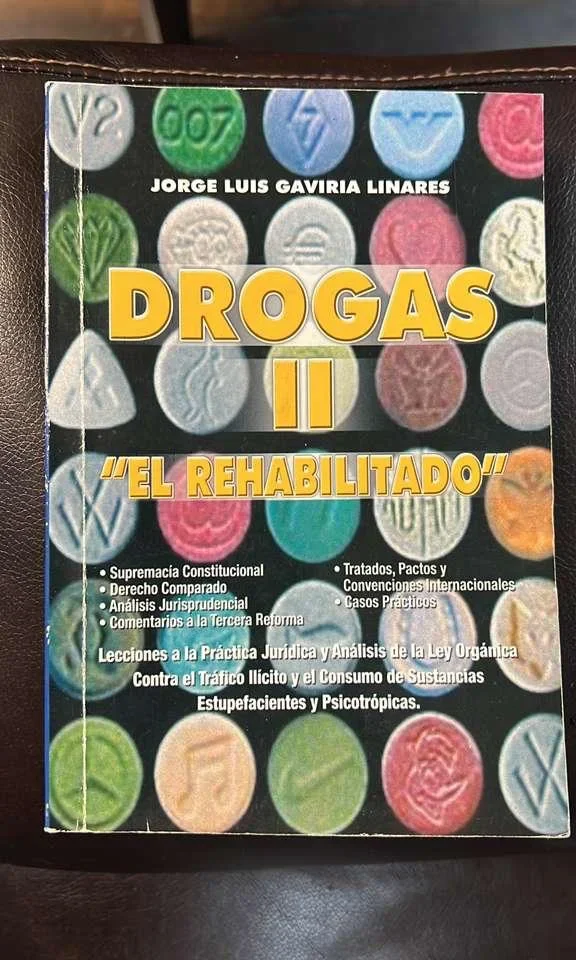
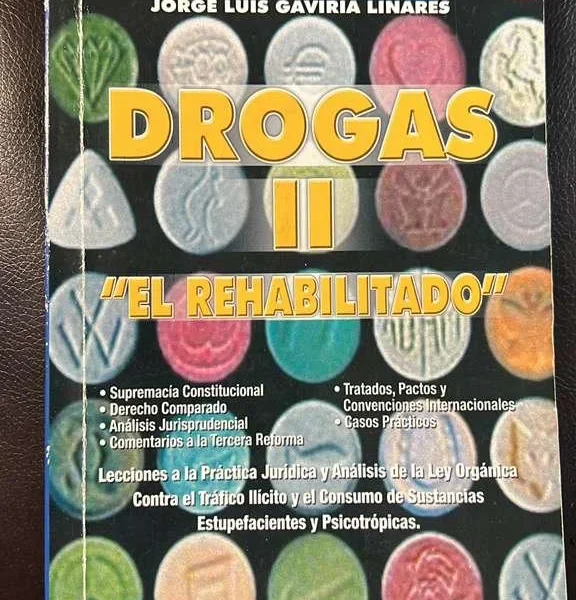
Several years ago I undertook the writing of Drogas II – El Rehabilitado, a project that was born from direct experience with the application of the Organic Law against Illicit Trafficking and the Consumption of Narcotic and Psychotropic Substances, as well as from the rigorous study of its jurisprudential interpretation and daily practice.
This book represents a natural continuation of my reflection on the phenomenon of drugs and its legal treatment, but with a more precise focus: the legal practice of the rehabilitated person in the face of the criminal and procedural norm.
My intention in preparing this work was clear from the beginning: it was not about writing a merely descriptive compendium of legal articles or reiterating doctrinal dogmas, but rather about offering a critical, practical and humanly sensitive guide on how the criminal law and its interpretation are translated into judicial decisions and concrete effects on people. This implies that the book brings together legal theory with lived experience, with special attention to those who, after criminalized behavior, are subject to criminal action and seek not only a sentence, but a dignified reintegration into society.
In The Rehabilitated, the reader will find a deliberately practical approach. Each chapter is structured to explore key aspects of criminal law on drugs: from the objective elements of the criminal offense to the application of sanctions and alternative measures that favor social reintegration.
This orientation is based on the conviction that criminal law, in addition to sanctioning, must offer paths that integrate courage and hope in those who have crossed the threshold of conflict with the law.
The work examines in detail the Organic Law against Illicit Trafficking and the Consumption of Narcotic and Psychotropic Substances, not only from its letter, but from its spirit and its practical effects.
I analyze the mechanisms that the law establishes to distinguish between punishable behaviors and those that must be treated with a therapeutic or rehabilitative approach, highlighting the need for interpretive criteria that respect the principles of proportionality, legality and restorative justice.
This book was written with the knowledge that rules are only as effective as the understanding of those who apply them.
This book was written with the knowledge that rules are only as effective as the understanding of those who apply them.Por ello, he dedicado amplios segmentos a la jurisprudencia, no como un catálogo de fallos, sino como una fuente viva que ilumina cómo los tribunales han interpretado y aplicado la ley a partir de situaciones reales.
I believe that this jurisprudential review not only helps to understand the Law in its current state, but also allows us to visualize interpretative paths that can strengthen a more equitable and coherent administration of justice.
In addition, I have included critical reflections on some of the most controversial assumptions of the law, proposing interpretive criteria that favor not only legal logic, but also human equity. This technical and humanistic duality is what I have sought to cultivate throughout the entire text.
Practical experience in courts, combined with academic study, led me to formulate specific proposals to improve the application of the law in situations that today generate doctrinal or interpretative tensions.
These proposals are not presented dogmatically, but rather as argued convictions, the result of direct observation and analysis of specific cases.
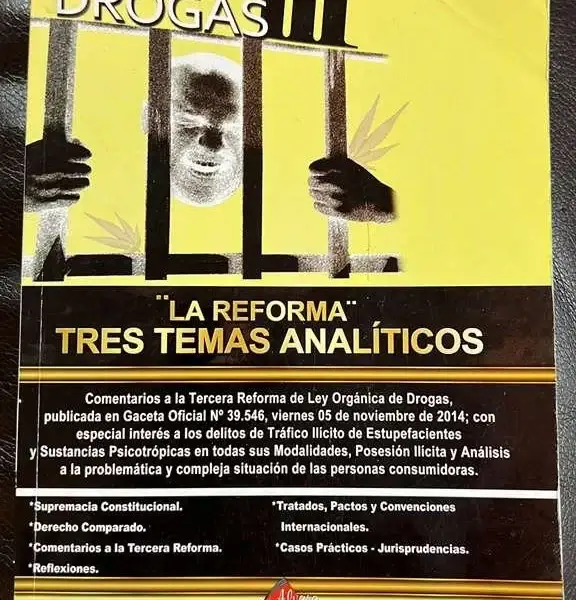
It is my hope that Drogas II El Rehabilitado serves both as a consultation tool for justice operators, public defenders, prosecutors and judges, as well as a source of reflection for law students and for any reader interested in understanding the complexity of the legal phenomenon of drugs from a critical and applied perspective.
Finally, this book is an invitation to look beyond the punitive sanction, to consider the value of rehabilitation and social reintegration as axes of a Criminal Law that not only punishes, but also humanizes.











 https://rss.com/podcasts/bitacora-literaria/